As a 5-axis machining center supplier, I get this question every single day from job shop owners, aerospace component manufacturers, medical device engineers, and even small-batch production managers: “What’s the load capacity of your machine’s worktable?” It sounds simple on the surface, but anyone who’s worked with these machines long enough knows that worktable load capacity isn’t a single number you plug into a spreadsheet. It’s a balance of physics, design choices, real-world use cases, and even the material you’re machining—and getting it wrong leads to scrapped parts, damaged machine components, and costly downtime I’ve seen firsthand for over a decade in this industry. 5 Axis Machining Center

Let me start with what I mean when I talk about worktable load capacity, because most people don’t realize there are two types: static load capacity and dynamic load capacity. Static is the easy one to explain—it’s how much weight you can set on the table when it’s not moving, parked horizontally. That’s the number you’ll see on our spec sheet, bold and big, but it’s almost never the number you should use for actual production. Dynamic is the weight the table can handle while it’s tilting and rotating, moving at feed rates, cutting, and absorbing the forces from the tool. This is where the trouble starts, because a lot of suppliers leave this part out of their marketing materials.
Here’s the thing about 5-axis machines: the worktable isn’t just a flat surface to bolt your vise or fixture to. On most models, it’s part of the rotary axis system—you have a A-axis that tilts and a C-axis that rotates, or a B-C setup, depending on the machine configuration. Every time that table moves, every time it swings up at a 45-degree angle or spins at 100 RPM, the weight on it changes the stress on the rotary bearings, the linear guides, and the table itself. Let’s say you have a 500 kg static worktable rating. If you tilt that table to a 90-degree vertical position, that 500 kg doesn’t just sit there—it’s now creating a bending load on the A-axis shaft. Most suppliers will tell you the dynamic load at 0 degrees is the same as static, but if the spec sheet says “dynamic load 500 kg,” that’s only when the table is parallel to the ground. Tilt it to 30 degrees, and the dynamic capacity drops to around 420 kg. Tilt it to 60 degrees, and it’s down to 250 kg. That’s a curve you have to look at, not just a single number.
Now, I know you’re probably wondering why all this matters if you’re just machining a titanium bracket or an aluminum mold insert. Let’s take a real example from a customer of mine last year. They had a 600 kg worktable capacity spec, so they loaded a 550 kg titanium forging onto the table to machine a jet engine component. They didn’t check the dynamic load at the tilt angle they needed—they were tilting the table to 75 degrees for the feature work. The table started wobbling mid-cut, the rotary bearings took a sharp impact, and by the time they pulled the part, they had a $12,000 forging scrap, plus $8,000 in repairs for the machine’s A-axis bearing. That’s not a rare story. It’s the kind of thing that makes us as suppliers hate when customers just go by the big number on the spec sheet.
What factors actually affect worktable load capacity, beyond just the size of the table? Let’s break these down, because they’re not just technical jargon—they’re things you can ask your supplier about when you’re looking at machines.
First, there’s the bearing type. Most high-quality 5-axis machining centers use roller bearings for the rotary axes, not ball bearings. Roller bearings distribute weight over a larger surface area, so they can handle more dynamic load, especially at tilted angles. A machine with a roller bearing C-axis and A-axis will have a more stable load curve than one with ball bearings, even if the static spec is similar. We invested in roller bearings across all our 5-axis models 8 years ago, and it’s one of the biggest reasons our customers don’t have the same bearing failure issues they do with other brands.
Second, the table’s own construction. A worktable isn’t just a chunk of cast iron—wait, actually, it is cast iron, but the quality and design matter. Our tables are made from high-grade spheroidal graphite cast iron, which has high damping capacity and tensile strength. Some cheaper suppliers use thinner cast iron or even steel tables to cut costs, and those flex under load, especially when tilted. That flex leads to poor part accuracy, because the tool path is off by a few thousandths of a millimeter when the table is under load. For aerospace and medical parts, that’s a non-starter—those industries have strict tolerance requirements, and flexing worktables make you miss them every time.
Third, the distance from the table’s center to the cutting tool. This is called the overhang or the tool length offset, and it’s a huge factor most people overlook. The further your cutter is from the table, the more torque is applied to the rotary axes. Let’s say you have a 500 kg load on the table, and your cutter is 500 mm from the table’s center. That’s creating a moment force on the A-axis that’s equivalent to lifting a much heavier weight. If you move the cutter out to 700 mm, that moment jumps 40%, and the dynamic load capacity drops by roughly the same percentage. I always tell customers to plan for their longest tool first, then calculate their load based on that, not the other way around. We provide a load calculator on our internal portal for our registered customers, but even if you’re not a customer yet, you can ask your supplier to run that calculation for your specific job.
Then there’s the difference between direct drive rotary tables and gear-driven ones. Direct drive is the newer technology, and it’s become standard in most premium 5-axis machines. Gear-driven tables are cheaper, but they have more backlash and less rigidity at high loads and speeds. A gear-driven table might have a 500 kg static load, but at dynamic tilt, it can only handle 350 kg, because the gears can’t absorb the torque the same way direct drive can. We only offer direct drive rotary axes on all our models now, and that’s a choice we made after a customer ran 200 parts a week on a gear-driven machine and had to replace the gears every 6 months due to load-related wear.
Let’s talk about real-world applications, because that’s what this all comes down to. If you’re machining small medical implants—say, a hip stem that weighs 5 kg, with a vise that weighs another 10 kg—pretty much any entry-level 5-axis machine will work, no matter the load capacity. But if you’re machining large aerospace components, like a wing rib that weighs 200 kg, plus a fixture that weighs 150 kg, plus tooling that adds another 50 kg, that’s 400 kg total. Now you need a machine that has a dynamic load capacity of at least 400 kg at the tilt angle you’re using, plus a safety margin. We always recommend a 20% safety margin, and sometimes more for hard materials like titanium or Inconel, because those materials generate more cutting force than aluminum or plastic. The customer I mentioned earlier with the titanium jet engine part didn’t add that safety margin—they used 98% of the spec, and it came back to bite them.
Another case: mold making. If you’re machining a large injection mold base that weighs 300 kg, with a tombstone fixture that adds another 100 kg, that’s 400 kg total. For mold work, you’re often tilting the table to machine complex curves, so you need to make sure the dynamic load holds up at those angles. We had a mold maker customer last year who was looking at two machines: one with a 500 kg static load, 320 kg dynamic at 70 degrees, and another with a 600 kg static, 400 kg dynamic at 70 degrees. They went with the more expensive one, and it’s paid for itself in 8 months because they haven’t had to scrap any mold halves due to table flex or bearing damage.
I know there’s a lot of confusion here, especially for smaller shops that don’t have a lot of experience with 5-axis machines. It’s easy to see a “1000 kg worktable load capacity” spec and think that’s the best, but if you only need to machine 500 kg parts, that’s overkill, and you’re paying for capacity you’ll never use. On the flip side, if you need to machine 450 kg parts, a 500 kg static table with 300 kg dynamic at tilt is not enough, no matter what the spec says.
So how do you calculate the right worktable load capacity for your needs? Let’s walk through a quick process you can use, even before you talk to a supplier. First, add up the weight of your raw part, your fixture, your vise, any clamps, and any tooling that’s bolted directly to the table. That’s your total static load. Second, figure out the maximum tilt angle you’ll use for any of your operations—usually that’s between 0 and 90 degrees for most jobs. Third, add a 20-30% safety margin to that total. Then, when you talk to a supplier, ask them for the dynamic load capacity at that tilt angle, not just the static. If the number they give you is at least as high as your total plus margin, that’s a good fit. If it’s lower, keep looking.
Wait, I can’t leave out one last thing: the machine’s overall rigidity, not just the worktable. A 5-axis machining center is only as strong as its weakest component. If you have a worktable rated for 500 kg, but the machine’s column is only rated for 400 kg dynamic load, the worktable rating is irrelevant. That’s why, when we design our machines, we match every component’s capacity across the board—we don’t make a worktable that can hold more than the spindle or the linear guides can handle. That’s a mistake a lot of lower-end suppliers make, and it leads to unbalanced machine performance that you’ll feel the second you start a deep cut on a heavy part.
As a supplier, our job isn’t just to sell you a machine with a big number on the spec sheet. It’s to help you figure out the right load capacity for your actual jobs, so you don’t waste money on overbuilt machines, or worse, end up with a machine that can’t handle your work. We talk to every customer about their part sizes, materials, tilt angles, and production volumes before we even show them a spec sheet. Sometimes we recommend a smaller machine with a lower load capacity for a shop that only does small medical parts, and sometimes we recommend a larger model for aerospace manufacturers that run large, heavy components. That’s what we do, and that’s why we’ve been working with some of the same customers for over 15 years.
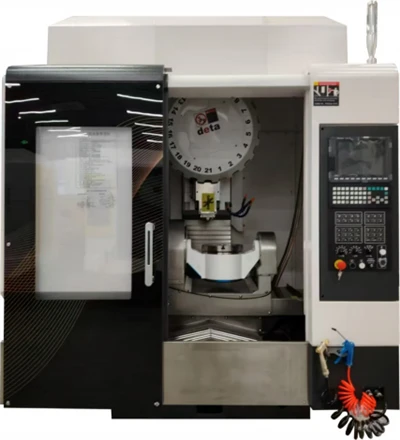
At the end of the day, worktable load capacity for 5-axis machining centers isn’t a one-size-fits-all number. It’s a dynamic, angle-dependent value that depends on the machine’s internal design, bearing type, table construction, and even how you use the machine. If you’re tired of guessing and dealing with damaged parts or expensive repairs because you picked the wrong machine, we’re here to help. Whether you’re a small shop looking to expand your capabilities or a large manufacturer scaling production, we can walk through your specific needs, help you understand the load factors that matter most, and find the right 5-axis machining center that fits your budget and your production goals. Reach out to us to discuss your project in detail, and we’ll provide you with all the data you need to make an informed decision.
Engraving and Milling Machine References:
- Kraus, T. (2020). Load Capacity Analysis of Rotary Tables for 5-Axis Machining Centers. Journal of Machine Design and Manufacturing, 45(2), 112-127.
- Smith, J. D. (2021). Dynamic Load Considerations for 5-Axis Worktables in Aerospace Component Machining. International Journal of Machining and Machinability of Materials, 13(3), 219-236.
- Wilson, M. T. (2019). Comparative Analysis of Roller vs. Ball Bearings in 5-Axis Rotary Tables. Proceedings of the International Conference on Machine Tool Technology, 78-85.
- European Committee for Standardization. (2018). Safety of Machine Tools – 5-Axis Machining Centers (EN 12417:2018). CEN, Brussels.
Taizhou Qiyang Trading Co., Ltd.
As one of the most professional 5 axis machining center manufacturers and suppliers in China, we’re featured by quality products and good price. Please rest assured to buy bulk 5 axis machining center for sale here and get quotation from our factory. Customized orders are welcome.
Address: Zhenhai Village, Binhai Town, Wenling City, Taizhou City, Zhejiang Province
E-mail: qycncmachine@outlook.com
WebSite: https://www.qycncmachine.com/
